Professional Email Signature Guide for Doctors & Physicians
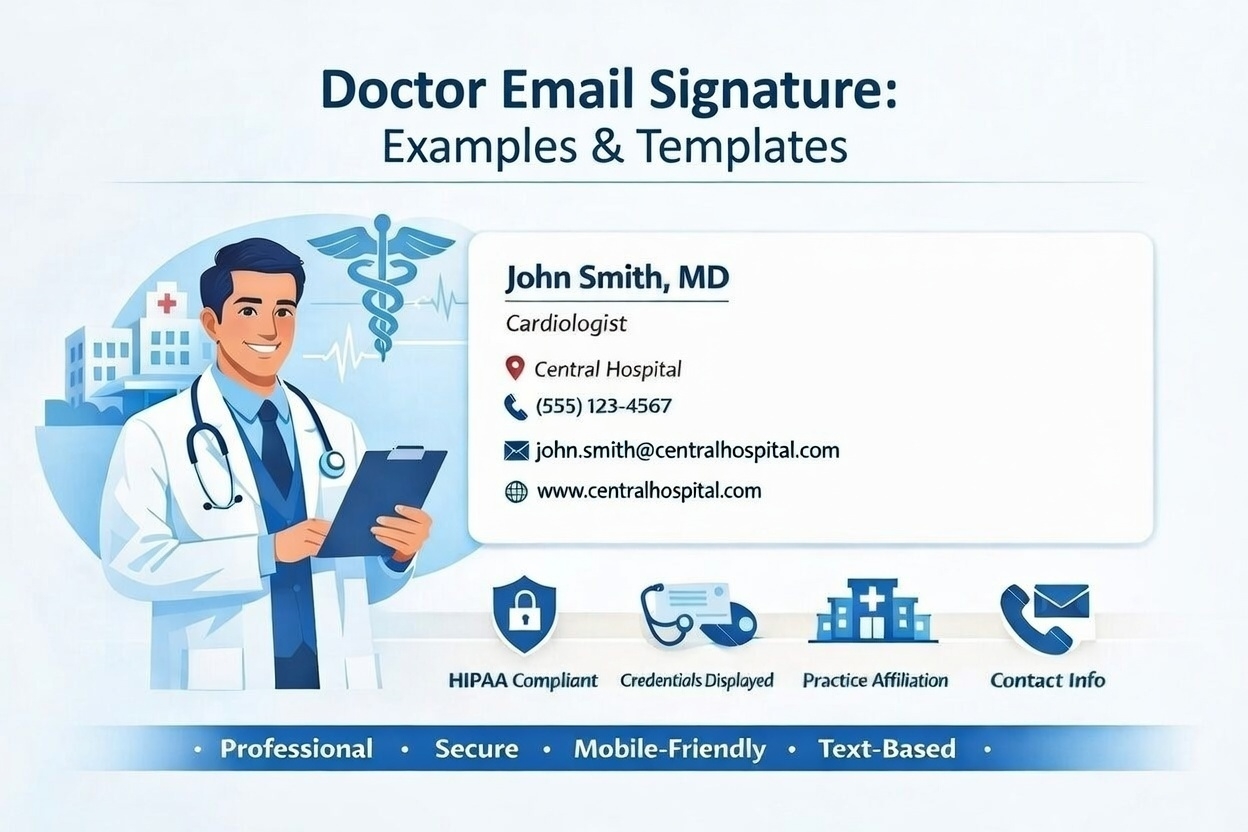
Your doctor email signature represents you in every patient communication, specialist referral, colleague consultation, and hospital administration correspondence. Unlike corporate professionals who focus on branding, physicians face unique requirements: HIPAA compliance, proper medical credential formatting, and clear institutional affiliations that build patient trust and establish professional credibility.
A well-crafted medical doctor email signature demonstrates professionalism, ensures regulatory compliance, and provides essential contact information while maintaining the clinical authority patients and colleagues expect from healthcare providers.
Create your professional doctor signature in under 5 minutes.
What Makes an Effective Doctor Email Signature
A physician email signature serves two critical functions: providing contact methods patients and colleagues need while communicating your medical credentials and institutional affiliation.
Essential Elements for Medical Professionals
Every physician email signature should contain these strategic components:
Full Name with Credentials: John Smith, MD or Jane Doe, DO. Include degree credentials (MD, DO) immediately after name. Avoid redundant “Dr.” prefix when using post-nominal credentials—use either “Dr. John Smith” OR “John Smith, MD,” never both.
Medical Specialty or Title: “Cardiologist”, “Family Physician”, “Chief of Surgery”, “Medical Director”. Clear specialty designation helps patients understand your clinical focus and colleagues route referrals appropriately. Administrative titles (Chief, Director, Department Head) indicate leadership responsibilities beyond clinical practice.
Hospital/Practice Affiliation: Hospital name, clinic, or private practice name. Institutional affiliation provides context for your clinical setting, establishes credibility through recognized healthcare brands, and helps patients locate facilities for appointments.
Phone Number: Direct office line or hospital extension. Patients need reliable contact methods for appointment scheduling, clinical questions, and urgent follow-up. Ensure the number connects to office staff who can access your calendar and handle medical inquiries appropriately.
Professional Email Address: Institutional email is required for HIPAA-compliant patient communication. Personal email domains cannot be used for protected health information exchange.
Hospital/Practice Website: Institutional website or practice URL. Provides patients with additional resources like office hours, appointment scheduling, insurance information, and directions to your facility.
Optional elements (include only when relevant):
- Medical license number (if required by state medical board regulations)
- Board certifications/Fellowships (FACP, FACS) only when directly relevant to specialty practice
HIPAA Compliance Considerations
HIPAA regulations create specific requirements for physician email signature formatting and email infrastructure.
Institutional email domain is mandatory. All patient communication containing protected health information (PHI) must use hospital or practice email systems with proper security controls. Personal email domains cannot be used for discussing patient care, diagnoses, or treatment plans.
Use secure email systems for PHI discussions. Beyond signature formatting, ensure your email platform provides encryption, audit trails, access controls, and other HIPAA-required safeguards when discussing patient care with colleagues or communicating with patients.
Important clarification on disclaimer text: HIPAA compliance disclaimers (“This email may contain confidential information…”) are NOT included in personal email signature blocks. These disclaimers belong in organizational email system settings or footer policies applied automatically to all outgoing messages, not in individual physician signatures.
Photos and Headshots
While professional headshots strengthen LinkedIn profiles and hospital websites, they actively harm doctor email signature effectiveness in clinical email correspondence.
Technical problems with photos:
Image files significantly increase email size, which triggers spam filters that automatically route messages to junk folders—problematic when time-sensitive patient communications or urgent colleague consultations need reliable delivery.
Email clients block external images by default for security reasons, causing formatting problems that undermine professional presentation.
Large image attachments slow email loading, particularly problematic for colleagues checking messages between patient appointments or reviewing communications on hospital WiFi networks with limited bandwidth.
Professional concerns:
Photos appear unnecessary in medical email correspondence. Unlike industries where personal branding and visual recognition drive business relationships, medical practice focuses on clinical expertise, institutional affiliation, and professional credentials rather than appearance.
Images create inconsistent displays across platforms. Different email clients (Outlook, Gmail, Apple Mail) render embedded images differently, causing formatting problems that undermine the professional presentation physicians need when communicating with patients, specialists, and hospital administrators.
Recommendation: Use text-only HTML signatures for all physician communications. Save professional photos for hospital websites, LinkedIn profiles, and directories where visual presentation serves legitimate purposes. A clean, text-based HTML healthcare email signature maintains professionalism across all medical correspondence.
Mobile Optimization
Patients and colleagues review emails on smartphones between appointments, during rounds, and outside office hours. Your medical doctor email signature must remain readable on small screens without horizontal scrolling or formatting problems.
Text-based HTML formatting adapts automatically to narrow mobile viewports. When signatures use simple text without tables, images, or complex HTML structures, content reflows naturally to fit smartphone screens. Contact information stays visible, phone numbers remain clickable for immediate calling, email addresses work as tap-to-email links, and website URLs open directly in mobile browsers.
Professional presentation persists across all devices. Simple text HTML formatting ensures your credentials, hospital affiliation, and contact details display consistently whether patients read emails on desktop computers, tablets, or smartphones—maintaining professional standards regardless of how recipients access their messages.
Avoid complex HTML that breaks on mobile. A properly formatted email signature for doctor communications should use a simple text structure that adapts seamlessly to any screen size.
Doctor Email Signature Examples
These medical email signature examples demonstrate proper formatting for various medical specialties and practice settings. Each maintains HIPAA compliance while clearly communicating credentials and institutional affiliations. Whether you’re a primary care physician in private practice, hospital-based surgeon, pediatric specialist, or medical administrator, these templates provide proven formatting that establishes professional credibility.
Example 1: General Practitioner / Family Physician
Dr. Jennifer Davis
Family Physician
Riverside Medical Group
(555) 234-5678
jennifer.davis@riversidemedical.com
riversidemedical.com
Why it works: Clean doctor email signature for primary care. “Family Physician” clearly indicates specialty focus on comprehensive patient care across all ages. Private practice affiliation (Riverside Medical Group) establishes practice setting. Professional institutional domain (riversidemedical.com) ensures HIPAA compliance for patient communication. Simple vertical format provides all essential contact information without unnecessary complexity.
Best for: General practitioners, family physicians, primary care doctors in private practice settings.
Example 2: Hospital-Based Physician (Surgeon)
Michael Rodriguez, MD, FACS
Chief of General Surgery
Metropolitan Hospital
(555) 789-2341
m.rodriguez@metrohospital.org
metrohospital.org/surgery
Why it works: This hospital email signature includes FACS fellowship (Fellow, American College of Surgeons) demonstrating board certification and surgical specialty expertise. “Chief of General Surgery” indicates leadership role managing surgical department. Hospital institutional domain (.org extension) essential for HIPAA-compliant patient communication and colleague consultation. Department-specific URL (metrohospital.org/surgery) directs referrals to appropriate specialty services.
Best for: Hospital-based surgeons, department chiefs, surgical specialists with administrative responsibilities. This surgeon email signature format works particularly well for specialists who need to communicate authority through both clinical credentials and leadership titles.
Example 3: Pediatrician (Clinic)
Dr. Sarah Chen
Pediatrician
Children's Health Clinic
(555) 432-8765
sarah.chen@childrenshealth.com
childrenshealth.com
Why it works: Simple, clear doctor email signature template for pediatric practice. “Pediatrician” specialty designation immediately communicates focus on children’s healthcare. Clinic affiliation (Children’s Health Clinic) indicates dedicated pediatric facility rather than general practice. Institutional email ensures compliance with HIPAA requirements for communicating with parents about patient care. Straightforward formatting builds trust with parents seeking accessible, professional pediatric care.
Best for: Pediatricians in clinic settings, children’s healthcare providers in specialized pediatric facilities.
Example 4: Cardiologist (Specialist)
David Morrison, MD, FACC
Cardiologist
Heart & Vascular Institute, University Hospital
(555) 876-5432
d.morrison@univhospital.edu
univhospital.edu/cardiology
Why it works: FACC (Fellow, American College of Cardiology) shows board certification in cardiology specialty. Institute affiliation (Heart & Vascular Institute) indicates specialized cardiovascular care center within larger hospital system. University hospital .edu domain adds academic credibility and research affiliation. Specialty-specific URL (univhospital.edu/cardiology) helps referring physicians and patients find detailed information about cardiovascular services, treatment options, and clinical trials.
Best for: Cardiologists, cardiovascular specialists in academic medical centers or specialized institute settings.
Example 5: Medical Director (Administrative)
Robert Martinez, MD
Medical Director
Summit Healthcare System
(555) 345-6789
robert.martinez@summithealthcare.org
summithealthcare.org
Why it works: “Medical Director” indicates administrative leadership role distinct from direct clinical practice. Healthcare system affiliation (rather than specific hospital or clinic) shows organizational scope spanning multiple facilities. This medical doctor email signature appropriate for someone balancing clinical credentials with executive responsibilities. Essential for administrators requiring professional presentation in external communications with health plans, regulatory agencies, community partners, and system-wide correspondence.
Best for: Medical directors, chief medical officers, healthcare administrators with MD credentials in leadership roles.
Example 6: Internal Medicine Physician
Amanda Foster, MD
Internal Medicine Physician
Lakeside Medical Center
(555) 567-8901
amanda.foster@lakesidemedical.com
lakesidemedical.com
Why it works: Clear specialty designation (“Internal Medicine Physician”) indicates focus on adult patient care and complex disease management. Medical center affiliation establishes institutional setting. Institutional email for HIPAA-compliant patient communication. No unnecessary credentials beyond MD degree—additional fellowships not needed unless subspecializing (e.g., FACP if focusing on specific internal medicine subspecialty). Simple physician email signature format maintains professionalism without over-complication.
Best for: Internal medicine physicians, hospitalists, general medicine specialists in hospital or clinic settings.
Example 7: Compact Physician Signature (Inline)
James Park, MD | Cardiologist at Memorial Hospital
(555) 234-9876
james.park@memorialhospital.org
memorialhospital.org/cardiology
Why it works: Compact physician email signature combining specialty and hospital affiliation in single line. Saves vertical space while maintaining clarity—useful for physicians managing high-volume email correspondence. Professional institutional domain ensures HIPAA compliance. Inline format particularly effective for email-heavy communication roles where signature brevity matters (e.g., responding to multiple consultation requests, managing referral communications, coordinating with multiple specialists).
Best for: Physicians preferring compact format, specialists in email-intensive coordination roles, doctors managing high-volume professional correspondence.
Generate these formats instantly with a doctor email signature generator—properly formatted and hipaa compliant email signature ready in 5 minutes.
Email Signature Generator for Doctors
A medical email signature generator eliminates formatting complexity while ensuring HIPAA compliance and professional credential presentation. Focus on patient care, not signature troubleshooting. Manual signature creation creates unnecessary technical problems and compliance risks during time-sensitive medical communications when reliable professional presentation matters most.
Why Use a Generator for Medical Professionals
Formatting consistency across all communications. Professional appearance in every patient email, colleague consultation, specialist referral, and hospital administration communication builds credibility across all professional touchpoints. Consistent formatting demonstrates attention to detail—a quality patients value when selecting physicians and colleagues appreciate when coordinating care.
Proper medical credential formatting guaranteed. Automatic formatting ensures correct MD/DO placement, appropriate comma usage with fellowships (FACP, FACS), and proper spacing. Eliminates common errors like redundant “Dr.” with ”, MD” or incorrect periods in credentials that undermine professional presentation.
Easy updates when changing positions. Change hospital affiliations instantly when moving practices—critical during job transitions when you need updated signatures immediately for communications with new colleagues and patients. Update credentials as earned (fellowships, board certifications) without reformatting entire signature blocks. Modify contact information (new phone extensions, updated email addresses) without HTML troubleshooting.
Mobile-optimized for patient accessibility. Automatically adapts to smartphones where patients read appointment confirmations, treatment follow-ups, and prescription communications. Maintains readability across all devices without manual testing.
Time savings for busy physicians. Five minutes vs hours of manual HTML formatting and cross-platform testing. No technical knowledge required—focus clinical expertise on patient care, not signature debugging. Cross-platform compatibility guaranteed across Gmail, Outlook, Apple Mail, and hospital email systems.
How to Generate Your Doctor Signature
Creating your professional doctor email signature through a generator follows three straightforward steps optimized for medical professionals:
Step 1: Input Professional Information
Most signature generators use standard field labels like “Job Title” or “Company” rather than medical-specific terminology. Don’t worry—you can format your physician information correctly by following the examples shown above.
The preview will show your positioning displays correctly even though field labels don’t perfectly match medical terminology. For example:
- Use the “Company” field for your hospital name (displays as “Metropolitan Hospital”)
- Use “Job Title” field for your specialty (displays as “Cardiologist”)
- Add credentials directly to your name field (input “John Smith, MD” rather than separate fields)
The generator handles formatting automatically—just enter your information following physician email signature template patterns from examples, and preview confirms correct display before finalizing.
Step 2: Select Format Options
Choose layout based on your communication needs and personal preference:
Vertical format provides maximum clarity with each element on a separate line. Best for physicians who prioritize immediate readability and clear institutional affiliation display. Recommended for most medical professionals, particularly those in patient-facing roles where clarity matters most.
Inline format offers compact presentation combining specialty and affiliation in a single line. Saves vertical space while maintaining professional presentation. Useful for physicians managing high-volume email correspondence where brevity improves email scanning efficiency.
Both formats maintain text-only HTML structure for HIPAA compliance and reliable rendering across email platforms.
Step 3: Generate Clean Code
Receive professionally formatted signature code ready for installation:
HIPAA-compliant HTML using text-only structure without embedded images or external content.
Mobile-responsive design that adapts to all devices automatically.
Professional credential formatting with correct spacing and punctuation. Each medical email signature template follows healthcare industry standards.
Installing Across Platforms
After generation, deploy your physician email signature across all communication systems:
For Gmail: Reference this Gmail signature setup guide for complete installation instructions covering Gmail web interface and mobile app configuration.
For Outlook: Follow the Outlook signature setup guide addressing Outlook desktop application, Outlook web access, and Office 365 configurations.
Quick Summary
Effective doctor email signature design balances professional credential presentation with HIPAA compliance and technical reliability for medical communications.
Essential elements for every physician signature:
- Full name with medical credentials (MD, DO)
- Medical specialty or administrative title
- Hospital/practice affiliation
- Professional contact information (phone, institutional email)
- Hospital/practice website
Critical principles for medical professionals:
Institutional email domain mandatory for HIPAA compliance. All patient communication must use hospital or practice email systems with appropriate security controls.
Text-only HTML format ensures reliable delivery. Simple text signatures without embedded photos or complex HTML prevent spam filtering and ensure consistent display across all email platforms.
Mobile optimization ensures readability on all devices. Text-based HTML formatting adapts automatically to smartphone screens where patients and colleagues increasingly read medical correspondence.
Keep credentials relevant to current practice. Include MD/DO degree plus maximum 1-2 fellowships directly related to specialty.
HIPAA compliance requirements:
Institutional email domain required for all patient communication to ensure proper encryption, audit trails, and access controls mandated by HIPAA regulations.
Use secure email systems for PHI discussions. Beyond signature formatting, email platforms must provide encryption and other HIPAA-required safeguards.
Implementation: Doctor email signature generator creates HIPAA-compliant, professionally formatted signatures in 5 minutes. Standard generator fields work perfectly for medical professionals—just enter your information following physician email signature template formats from examples, and preview confirms correct display before deployment.
Impact: Professional medical doctor email signature presentation builds patient trust through clear credential display and institutional affiliation. HIPAA-compliant formatting protects patient privacy and meets regulatory requirements. Consistent presentation across all communications reinforces professional standing in the medical community.
Modern physician email signature and medical professional email signature design means clean text HTML formatting with proper credential presentation and HIPAA compliance. Every physician should prioritize professional standards, regulatory compliance, and clear communication in all email correspondence.
Create your professional doctor signature in under 5 minutes.